Tesla Unveils New Roadster With SpaceX Thrusters, Production Expected in 2028
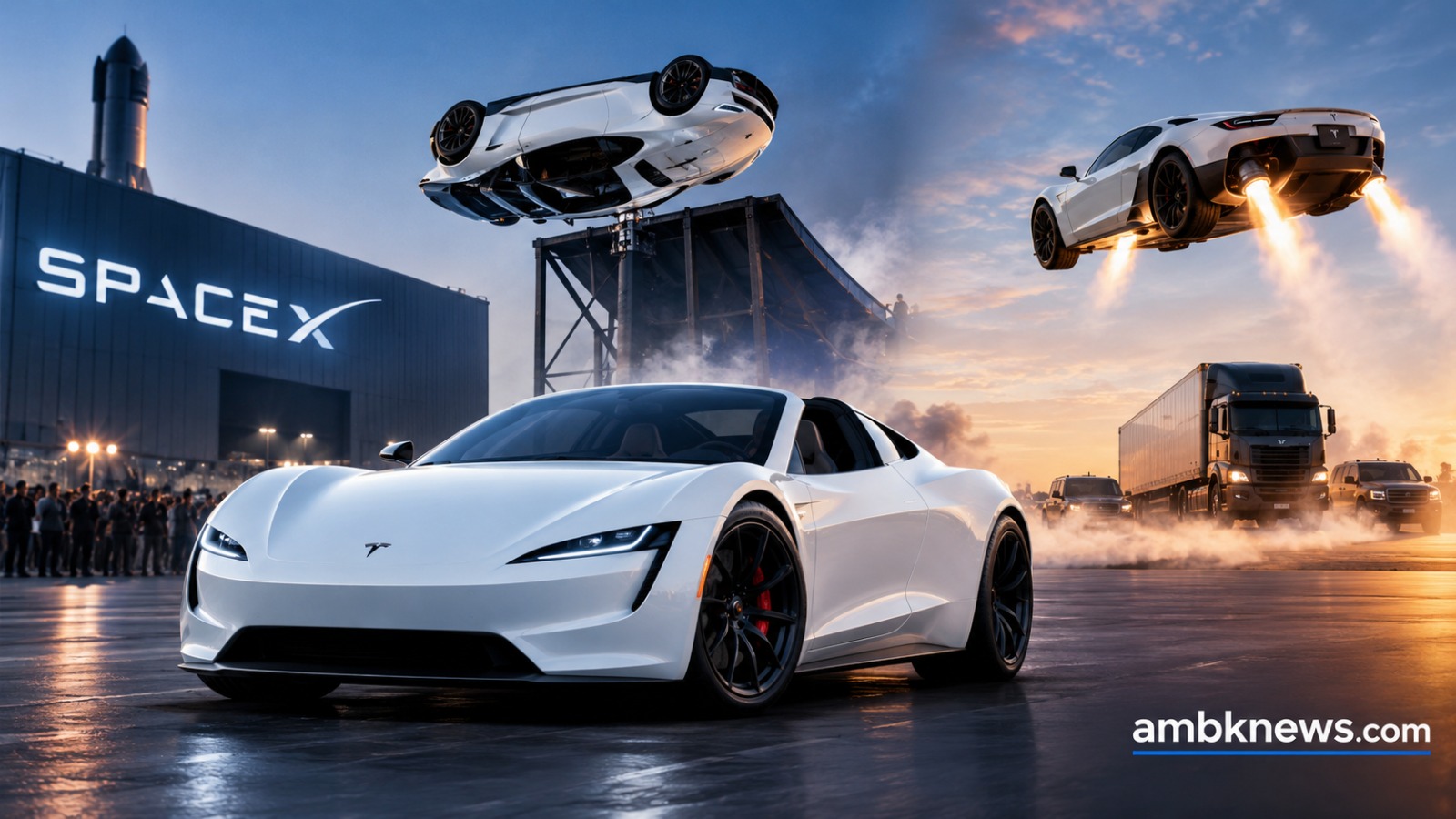
Tesla has unveiled a redesigned version of its long-awaited Roadster, featuring rocket-style thrusters developed with SpaceX. The electric sports car was showcased at an event in Texas, where demonstrations included dramatic aerial manoeuvres. However, customers may have to wait until 2028 for production to begin.
The reveal marks a fresh chapter for a vehicle that Tesla first previewed nearly a decade ago. The company had originally targeted deliveries in 2020, but repeated delays have pushed the next-generation Roadster far beyond its initial schedule.
Roadster Takes Centre Stage With SpaceX Technology
The white, two-seat sports car was demonstrated at a SpaceX test facility in McGregor, Texas. During the presentation, the vehicle performed a series of unusual stunts, including moving upside down along a ramp with the help of a suction system, rotating in mid-air and landing with assistance from its built-in thrusters.
Another demonstration showed the Roadster jumping over a truck and other vehicles while twisting in the air. The spectacle drew enthusiastic reactions from viewers, with some struggling to believe what they had witnessed.
Tesla CEO Elon Musk described the vehicle as the result of close collaboration between engineers at Tesla and SpaceX. The presentation featured dramatic lighting, smoke effects and a countdown, reflecting the theatrical style associated with many of Musk's product launches.
The close involvement of SpaceX has also fuelled speculation about a possible future combination of the two companies. Both businesses are controlled by Musk, who has previously discussed areas where their technologies and operations overlap. However, the Roadster unveiling did not establish that a merger would take place.
Tesla Promises Extreme Acceleration and High Performance
Tesla executives outlined ambitious performance targets for the new Roadster. Lars Moravy, the company's vice president of vehicle engineering, said the car could accelerate from zero to 60 miles per hour in less than one second and reach a top speed exceeding 230 mph.
Musk suggested that its potential performance could go even further, making the Roadster one of Tesla's most ambitious engineering projects.
The company also claims the vehicle will offer more than 300 miles of driving range on a single charge. While that would make it suitable for long-distance travel, the figure remains below the range Musk discussed when the second-generation Roadster was first introduced in 2017.
The latest demonstration focused heavily on acceleration, aerial manoeuvres and the car's experimental thruster system. Further details about the final production specification and how these features will work in a road-going vehicle have yet to be fully established.
Roadster Reservations Highlight Premium Positioning
Tesla's reservation page following the unveiling listed several versions of the vehicle, each aimed at a different level of performance.
The Performance version was shown with a $50,000 deposit, while the Thrust version, advertised with acceleration thrusters, required a $250,000 deposit. Tesla also described a Rocket variant as an invitation-only, single-seat model featuring a full flight system.
The company did not announce final retail prices during the event. When Tesla first introduced the next-generation Roadster in 2017, it quoted a starting price of $200,000.
The substantial reservation deposits and the proposed range of configurations position the Roadster as a premium vehicle. Final pricing, production specifications, delivery schedules and the availability of the more experimental features remain important details for prospective buyers.
A Symbolic Car as Tesla Shifts Towards AI and Robotics
The Roadster reveal comes at a time when Tesla is increasingly focused on artificial intelligence, autonomous driving and robotics rather than relying solely on conventional electric vehicle sales.
The company has been developing its Cybercab robotaxi, designed without traditional driver controls, alongside its Optimus humanoid robot programme. These initiatives reflect Tesla's ambition to expand beyond manufacturing cars for human drivers.
Against this backdrop, the Roadster could serve as a showcase for Tesla's engineering capabilities and brand identity. Morningstar analyst Seth Goldstein has described it as a potential halo car — a high-performance model intended to demonstrate a manufacturer's technology and design ambitions.
Tesla investor Gene Munster, meanwhile, characterised the launch as an impressive engineering demonstration but questioned its direct commercial value. His comments reflected a broader debate over whether the Roadster will have a meaningful financial impact or primarily strengthen the company's image.
Tesla Faces Pressure to Deliver on Its Promises
The Roadster's history makes the production timeline a key issue. Tesla first presented the second-generation model in 2017 and initially expected deliveries to begin in 2020. The latest production target of 2028 represents a substantial delay from that original plan.
The original Tesla Roadster, launched in 2008 and sold until 2012, played an important role in establishing the company's reputation. Based on a Lotus Elise chassis, it helped demonstrate that an electric vehicle could deliver sports-car performance.
Since then, Tesla has expanded its lineup with the Model S, Model 3, Model X and Model Y. The company now faces a different challenge: balancing its established electric vehicle business with ambitious plans for autonomous transport and robotics.
The Roadster could help renew excitement around the brand, but its ultimate impact will depend on whether Tesla can turn the latest demonstrations into a production vehicle that meets its performance claims and reaches customers on schedule.
Investors Will Be Watching the Numbers
Tesla's upcoming quarterly results are likely to draw considerable attention from investors, who are assessing the company's sales performance, profitability and cash flow.
Although higher petrol prices have provided some support for electric vehicle demand, Tesla has faced pressure from an ageing vehicle lineup and declining sales over the past two years.
Josh Gilbert, lead analyst for Asia-Pacific at eToro, said financial measures such as margins and cash flow would carry more weight with investors than the Roadster presentation itself.
The new sports car has certainly generated attention, but its commercial significance remains uncertain. For Tesla, the next major test will be delivering on its ambitious promises while maintaining financial performance and advancing its broader technology strategy.