Japan's Mission to Bring Back Samples From a Martian Moon Targets 2031 Return
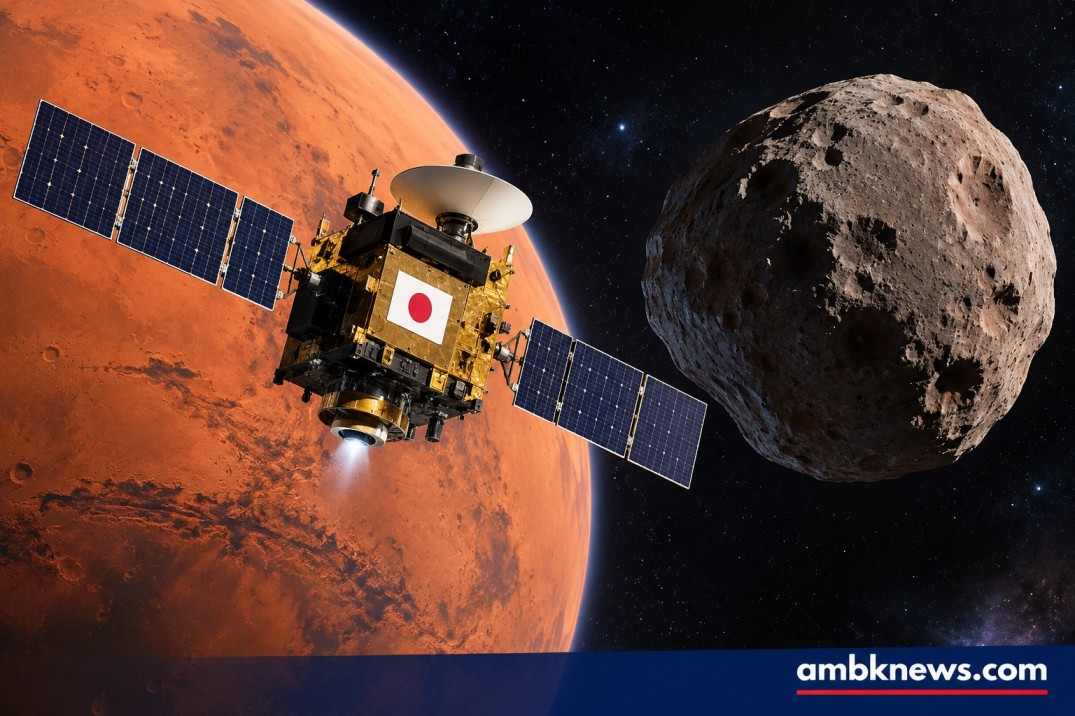
Japan is preparing for an ambitious space mission that aims to bring samples back to Earth from Phobos, one of Mars' two small, irregularly shaped moons. Led by the Japan Aerospace Exploration Agency (JAXA), the Martian Moons eXploration (MMX) mission is designed to help scientists understand how the moons formed and shed light on the early history of the Red Planet.
The mission is expected to take several years, with the spacecraft scheduled to return to Earth in 2031. It is intended to become the first mission to collect material from a Martian moon and deliver it to Earth for detailed laboratory analysis.
The launch is planned aboard Japan's H3 rocket. The project also involves international cooperation, with NASA and other space agencies contributing scientific instruments, sampling technology and communications support.
Scientists hope the findings will improve understanding of Mars and help researchers assess whether its moons could play a role in future human exploration of the planet.
Why Japan Is Targeting Phobos
Although numerous spacecraft have explored Mars since the 1960s, its two moons, Phobos and Deimos, remain poorly understood. Both have irregular shapes and heavily cratered surfaces, leaving important questions about their origins unanswered.
One theory suggests that the moons formed from debris thrown into orbit after a large object struck Mars. Another possibility is that they are asteroids captured by the planet's gravity.
JAXA scientists believe analysing samples collected directly from Phobos could help distinguish between these explanations.
Phobos is the larger and closer of Mars' two moons. It measures roughly 20 to 30 kilometres across and orbits the planet at a distance of approximately 6,000 kilometres, completing about three orbits in a Martian day.
Researchers also hope the samples will offer clues about Deimos, as the two moons may share a common origin. The MMX spacecraft will therefore observe Deimos during a planned flyby, alongside its main investigation of Phobos.
A Three-Year Study Around Phobos
The journey to the Martian system will take approximately a year after launch, followed by an extended period of scientific observations and sample collection.
Once it reaches Mars, the spacecraft is expected to spend around three years studying Phobos. It will examine the moon's surface, gather scientific measurements and identify suitable locations for collecting material.
The MMX spacecraft weighs approximately five tonnes and consists of three main modules: propulsion, exploration and sample return. While the spacecraft will conduct its mission around Mars, only the return module and its protected sample capsule are designed to travel back to Earth.
The mission carries 13 scientific instruments and technologies, including a small rover developed jointly by France and Germany. Other equipment includes a NASA-supported sampling device, a gamma-ray instrument, a European deep-space communications system and a Japanese radiation monitor.
These instruments will help scientists study the composition of Phobos, understand its environment and gather information relevant to future human missions to Mars.
Rover Will Prepare the Way for Sample Collection
The French-German rover, named Idefix, is expected to reach the surface of Phobos before the main spacecraft attempts to collect samples. During a planned mission lasting around 100 days, it will examine the terrain and help researchers identify suitable sampling locations.
Using observations from the rover and other instruments, the MMX team will select a relatively flat and safe landing site.
JAXA aims to collect at least 10 grams of material from Phobos through two sampling attempts. The spacecraft is designed to use both American and Japanese sampling techniques.
The NASA-developed approach uses pressurised gas to lift surface particles into a collection container. Japan's sampling system uses a coring mechanism to gather material from approximately two centimetres below the surface.
The first collection attempt is expected to gather surface and subsurface material, while the second will focus on obtaining additional underground samples.
Collecting material from different locations and depths could provide scientists with a broader picture of the moon's composition. Researchers also hope that traces of material originating from Mars may be present in the samples.
Could the Samples Reveal Clues About Ancient Life?
One of the scientific interests in the mission is the possibility that Phobos contains small amounts of material ejected from Mars by asteroid impacts.
Scientists estimate that Martian material could account for around 0.1% of the collected samples. If present, this material could provide an opportunity to study Martian rocks without having to land a separate sample-return spacecraft directly on Mars.
Researchers hope laboratory analysis may reveal information about the planet's geological history and past environmental conditions. The mission is not guaranteed to find evidence of past microbial life, but the samples could help scientists investigate questions related to Mars' ancient habitability.
The material collected from Phobos may also help explain the formation and evolution of the Martian moons themselves.
Landing on Phobos Presents a Major Challenge
Touching down on Phobos will be a delicate operation because the moon has extremely weak gravity approximately one two-thousandth of Earth's gravitational pull.
Its uneven, crater-filled surface makes selecting a safe landing location particularly important. The spacecraft must also collect its samples within a limited period during each landing operation.
To reduce the risk of bouncing or losing contact with the surface, the exploration module is equipped with four-legged landing gear designed to absorb the impact.
The Idefix rover has also been built to operate in the moon's low-gravity environment. Its wheels are designed to maintain traction, and the rover can recover if it tips over. It will move slowly while examining the terrain and supporting the main spacecraft's operations.
A Long Journey Back to Earth
After completing its observations and sample collection, the MMX spacecraft is expected to begin its return journey. The samples will be sealed inside a specially protected capsule designed to withstand the extreme heat of re-entry into Earth's atmosphere.
The capsule is expected to land in Australia before being transported to Japan for detailed scientific examination.
Japan already has experience returning extraterrestrial material to Earth through its Hayabusa missions, which delivered asteroid samples in 2010 and 2020.
The MMX mission builds on that experience but introduces a new challenge: collecting material from a moon orbiting another planet.
If successful, the mission could significantly advance scientific understanding of Phobos, Deimos and Mars. It could also provide valuable knowledge for planning future robotic and human exploration of the Martian system.